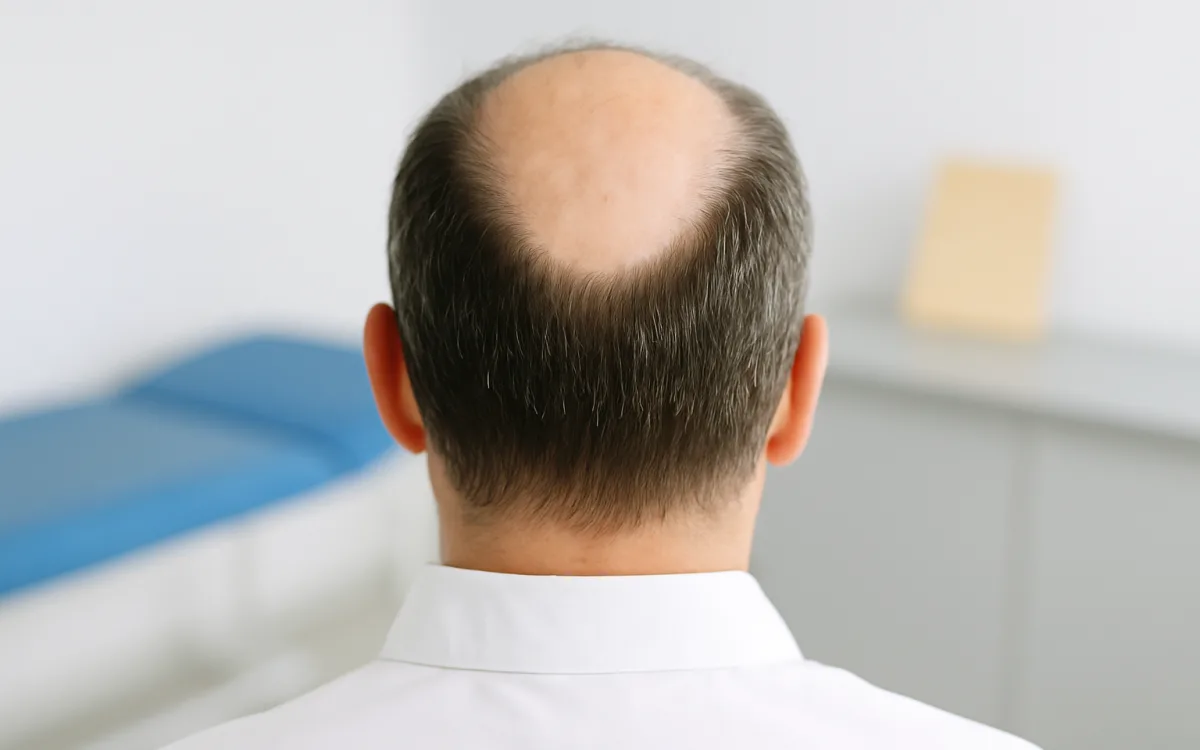
The Norwood Scale Explained Stage by Stage: Hair Loss Patterns and Graft Needs

When researching hair transplant Turkey options, one of the first tools you’ll encounter is the Norwood Scale—a visual guide that helps men identify the pattern and severity of their hair loss. Knowing your Norwood stage is essential for realistic planning, especially when estimating how many grafts you might need and what results are genuinely possible.
This article breaks down every stage in clear language, so you can match your own hair to the scale and understand how clinics use it to quote graft numbers and costs. We cover typical graft ranges, what each stage looks like in the mirror, why the scale isn’t used for women, and what the numbers mean for your candidacy and expectations.
What Is the Norwood Scale and Why Does It Matter?#
The Norwood Scale is the standard system for classifying male pattern baldness, ranging from minimal hairline recession to near-total scalp hair loss. Clinics in Turkey and elsewhere use it to assess how advanced your hair loss is, estimate how many follicular unit grafts you may require, and advise on what’s realistic to achieve with a hair transplant. It’s a reference, not a diagnosis, and understanding your stage helps when reading clinic offers or discussing your goals. The scale’s stages are based on visual patterns—so you can compare your own hair in the mirror, rather than guessing based on age or feelings. However, the Norwood Scale only applies to men with androgenetic alopecia, and not to women or those with other causes of hair loss.
Matching Your Hair Loss: Stage-by-Stage Descriptions#
- Norwood 1: Minimal or no recession. The hairline is essentially unchanged from youth.
- Norwood 2: Noticeable but mild recession around the temples; a subtle ‘M’ shape forms.
- Norwood 3: Deepening temple recession or a pronounced ‘M’ shape. Some thinning at the crown may appear.
- Norwood 3 Vertex: The front is similar to Stage 2, but there’s distinct hair loss at the crown (vertex), rather than the hairline.
- Norwood 4: Further frontotemporal recession and a larger bald spot at the crown, with a band of hair separating them.
- Norwood 5: The band of hair between front and crown thins, and bald areas start to merge.
- Norwood 6: The bridge is gone—front and crown balding unite, leaving only the sides and back with dense hair.
- Norwood 7: Severe loss; only a narrow horseshoe of hair remains on the sides and back.
Graft Estimates by Norwood Stage: What Clinics Typically Quote#
| Norwood Stage | Typical Graft Range | What’s Usually Achievable |
|---|---|---|
| 1 | 0–500 | Transplants rarely advised at this stage |
| 2 | 800–1,500 | Refining hairline; may not be necessary |
| 3 | 1,500–2,500 | Good coverage of receding hairline |
| 3 Vertex | 1,800–2,800 | Front or crown focus, not both |
| 4 | 2,500–3,500 | Restoring hairline and crown, but density varies |
| 5 | 3,000–4,000 | Partial coverage; full density unlikely |
| 6 | 4,000–5,500 | Large area; density is a compromise |
| 7 | 5,000–7,000 | Maximum coverage, often with visible thinning |
Your donor area’s density, hair type, and scalp laxity will determine your personal maximum—these are typical quoted ranges, not guarantees.
Norwood 3 vs. 3 Vertex: Spotting the Difference#
Many clinics in Turkey distinguish between Norwood 3 and Norwood 3 Vertex when planning surgery. Norwood 3 involves deeper recession at the temples, forming the classic ‘M’ shape, but the crown remains intact. Norwood 3 Vertex, on the other hand, shows a clear bald spot at the crown (the ‘vertex’), while the hairline recession is less severe. This difference matters, as grafts may be focused either on the front or the crown, but not both in a single session if donor supply is limited. Clinics often prioritise visible areas—so your expectations and goals should be discussed carefully before committing.
Why the Norwood Scale Doesn’t Apply to Women#
The Norwood Scale measures male pattern hair loss, which follows predictable patterns like receding temples and crown thinning. Female hair loss rarely matches these shapes; women usually experience diffuse thinning all over, rather than distinct bald patches. For women, the Ludwig or Savin scales are more appropriate. If you’re a woman considering hair transplant Turkey options, you’ll need a different assessment and should seek a clinic with experience in female hair restoration.
Estimating Costs: How Norwood Stage Affects Price in Turkey#
| Norwood Stage | Estimated Grafts | Typical Price Range (€) |
|---|---|---|
| 2–3 | 1,000–2,500 | 1,500–2,800 |
| 4 | 2,500–3,500 | 2,200–3,000 |
| 5–6 | 3,500–5,500 | 2,700–4,000 |
| 7 | 5,000–7,000 | 3,500–5,500 |
Prices vary due to clinic reputation, surgeon experience, technique (FUE, DHI) and inclusions like transfers or accommodation. Always request a written quote.
Limits and Trade-offs: When Surgery May Not Be Right#
- If your hair loss is minimal (Norwood 1 or early 2), surgery is usually unnecessary and may create an unnatural look.
- Younger patients (under 25) may not be good candidates, as hair loss can progress unpredictably.
- If your donor hair is sparse or fine, achieving high density across large bald areas may not be possible.
- Surgery cannot stop future loss—ongoing medical treatment may be needed.
- Unrealistic expectations about density or hairline shape can lead to disappointment.
- A reputable clinic will assess your candidacy honestly and may advise against surgery in some cases.
Questions people ask
How do I find my Norwood stage before seeking a hair transplant in Turkey?
Compare your pattern of hair loss to the Norwood Scale’s visual stages, focusing on temple recession and crown thinning. Use clear photos in good light, and if unsure, send images to a reputable clinic for an initial (non-diagnostic) assessment. Honest self-matching helps ensure realistic conversations about graft numbers and achievable results.
Can I have a hair transplant in Turkey if I’m Norwood 1 or 2?
Most clinics advise against surgery for Norwood 1, and many are cautious with Norwood 2. Transplanting at these early stages risks an unnatural look, as future hair loss may progress, making the transplanted area obvious. Non-surgical treatments and ongoing monitoring are usually better options until loss stabilises.
Why do clinics in Turkey quote different graft numbers for the same Norwood stage?
Graft numbers depend on several personal factors: scalp size, hair calibre, donor area density, and your goals for coverage or density. Different clinics may also have varying philosophies—some prioritise conservative, natural looks while others try to maximise coverage. Always ask for a detailed, written quote and a realistic explanation of what can be achieved for you.
Norwood Scale hair losshair transplant Turkeygraft estimate Norwoodmale pattern baldness stagesNorwood 3 vs 3 vertexhair transplant cost Turkey